
SELF-EFFICACY TRIFECTA
The Internal Architecture of Athlete Development
Talent identifies you. Self-efficacy is what determines what you do with it.
It is the internal belief system that sits beneath every performance decision an athlete makes — whether to push through or back off, speak up or stay quiet, try again or walk away. My research extends Bandura's foundational definition into the realities of the emerging athlete pathway — where self-efficacy is not a single stable trait but a trifecta of three interdependent resources: confidence, faith, and resilience.
Each one does different work. All three are shaped — deliberately or by default — by the environments athletes pass through and the people in them.
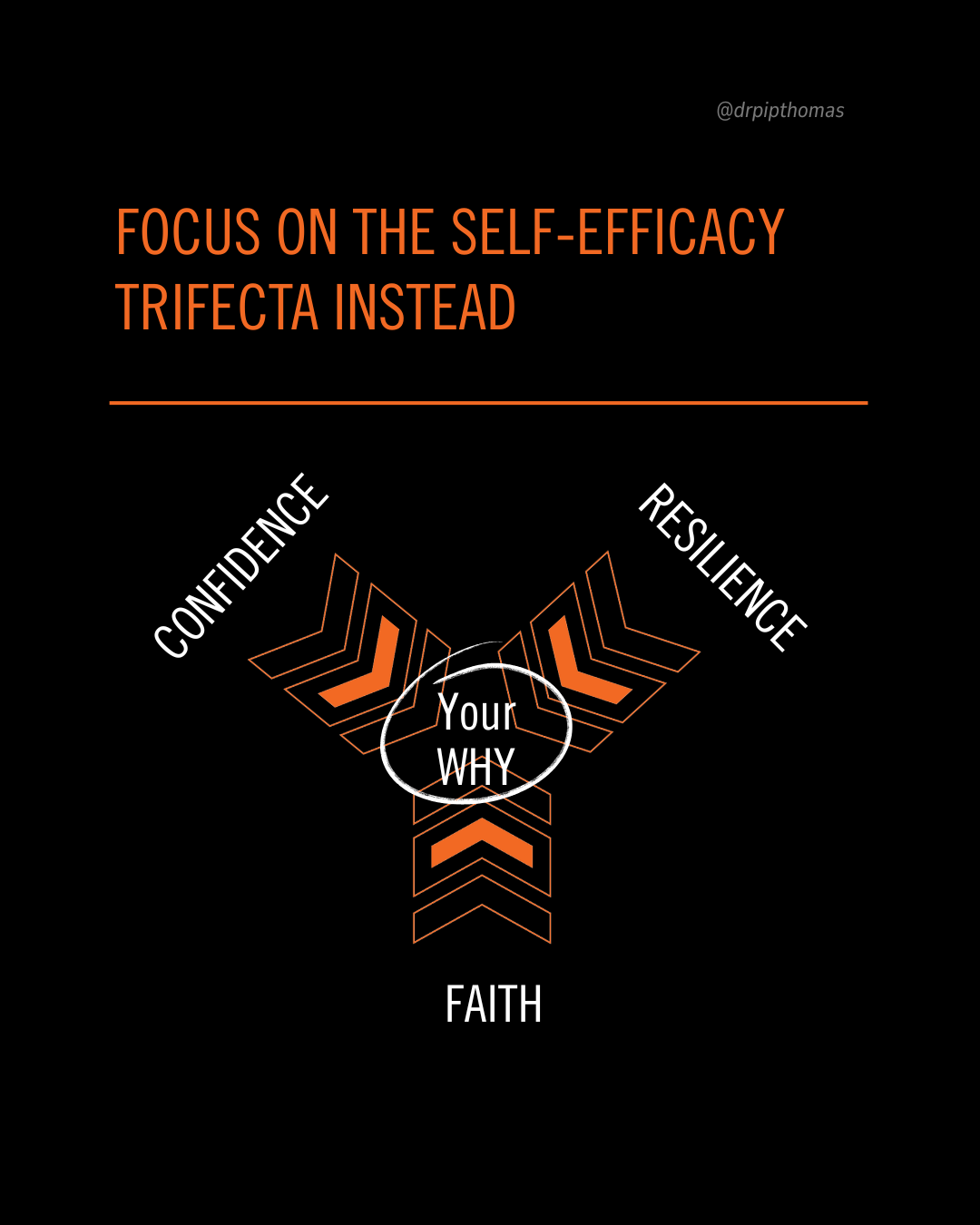
The Trifecta
Confidence — Belief in Your Readiness
Confidence is not arrogance and it is not bravado. It is the earned belief that you have prepared, done the work, and are ready to perform. It is dynamic — built deliberately over time through consistent effort and honest self-assessment — not a fixed trait you either have or don't.
In the pathway, confidence is fragile. De-selection, bench-warming, injury, migration, and the absence of honest feedback can dismantle it quickly. When an environment tells an athlete to "just be confident" while simultaneously doing the things that destroy it — the gap between the instruction and the reality becomes its own damage. Confidence is periodised — it needs to be built, protected, and rebuilt. That is as much the environment's responsibility as the athlete's.
Faith — The Root That Holds
Where confidence is situational and task-focused, faith runs deeper. It is a knowing stronger than belief — and unwavering trust in what I am chasing and why. Trust is not passive—but belief with choice and action. It builds an inner conviction that extends beyond any single performance or selection outcome to the pursuit itself. It is what keeps an athlete moving when confidence is shaken and the environment is not giving much back.
Faith is often grounded in cultural or spiritual practice, in family, in a sense of personal destiny, or simply in an unwavering trust in one's own trajectory. Whatever its source, it is the root that holds when everything else is being tested. Environments that recognise and support that inner spirit create the conditions for athletes to persist through difficulty. Those that ignore or inadvertently undermine it remove the one resource that no programme can manufacture.
Resilience — Ordinary Magic
Resilience is not mental toughness. It is the possession of resources and strategies to cope with any challenges and setbacks you face and and continue to GROW as an athlete and as a person. It is built through exposure to both wins and losses — prior experience with a situation means the next time it arrives, the athlete is better equipped to meet it.
Masten (2001) described resilience as ordinary magic — not a rare trait but a capacity that emerges through everyday relationships and experiences. That framing matters. It means resilience is not something athletes either have or don't — it is something environments either build or fail to build. The pathway is both the developer of that capacity and the resource from which athletes draw it when things get hard.
By Design, Not by Default
Self-efficacy does not arrive with talent. It is built — through the quality of the environments athletes pass through, the relationships they experience in them, and the deliberate investment of the coaches and practitioners around them.
An environment that builds confidence through honest feedback, supports the inner conviction athletes carry, and develops coping capacity through managed exposure to challenge produces athletes who are genuinely equipped for the demands of the pathway — and for what comes after it.
An environment that ignores these dimensions produces athletes who are physically capable but internally underprepared. The trifecta does not build itself. Neither does the environment that makes it possible.
Ready to build self-efficacy?
Whether you are an emerging athlete navigating the pathway or a coach building the environment around one — this is where the work gets specific. The first conversation is always free.
Note on the Research
Bandura, A. (1997). Self-efficacy: The exercise of control. Freeman.
Masten, A.S. (2001). Ordinary magic: Resilience processes in development. American Psychologist, 56(3), 227–238.
Thomas, P.G., Lucas, P., Walters, S., & Oldham, A.R.H. (2024). Emerging athletes' career transitions in professional sport: An existential multi-case perspective. Frontiers in Sports and Active Living, 6. Link to Paper
Thomas, P.G. (2023). Emerging athletes' transition in professional sport: An existential multi-case perspective Thesis Link. Auckland University of Technology.