
CONNECTION and RELATIONAL INTELLIGENCE
Relationships in the Emerging Athlete Pathway — and the Shared Responsibility to Build Them
The emerging athlete pathway is not a solo pursuit. Every step of it — from the first talent ID session to a professional contract, and everything in and beyond — is shaped by the relationships you are in. With coaches, teammates, managers, agents, family, and yourself.
Relational intelligence is your capacity to navigate those relationships effectively. To build genuine connections. To speak with courage when it matters. To communicate clearly across power dynamics and cultural differences. To seek help — and to give it.
My research is clear on this: connection in athlete pathways is not a one-way transaction. The most impactful support relationships are built on authenticity, mutual investment, and genuine care from both sides. Athletes who receive that kind of support develop better self-efficacy, cope more constructively under pressure, and navigate the inevitable setbacks of the pathway with more resilience. Coaches and practitioners who invest in those relationships consistently report greater meaning and fulfilment in their work. Connection, when it is real, benefits everyone in it — and these findings came directly from the people inside these environments. That need — to feel seen and valued — is universal.
Relational Intelligence
Relational intelligence is made up of three capacities — and they only work when they work together. Courage without connection is exposure without safety. Communication without honesty is performance without truth. Each one depends on the others, and all three can be deliberately developed.
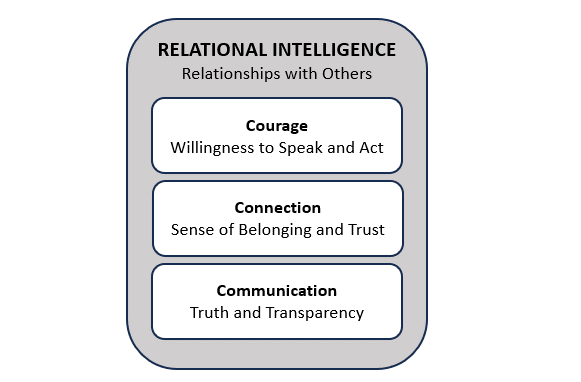
Courage — Willingness to Speak and Act
Courage is not the absence of fear. It is the capacity to act despite it. To say to a coach, "I don't understand my role." To tell a welfare manager, "I'm not okay." To question a contract that doesn't feel right. For many athletes — especially those from cultures where humility and deference to authority are deeply held values — this is genuinely hard.
The 18-year-old who missed training because he was too shy to ask for a ride. The athlete who knew something was wrong with a contract but said nothing because he didn't want to seem difficult. These are not character flaws — they are what happens when environments don't build courage in. Environments that reward honesty and normalise help-seeking cultivate courage. Environments that penalise vulnerability extinguish it.
Connection — Sense of Belonging and Trust
Connection is what keeps an athlete tethered to a sense of worth and belonging that performance outcomes alone cannot provide. In a pathway defined by cycles of selection, rejection, migration, and constant competition, the absence of genuine connection is not just uncomfortable — it is developmentally damaging.
Connection is built in small things over time. A coach who notices when something is off. A support person who shows up to training with no agenda. A senior player who makes you feel like you belong before you've earned it.
"There is a lady here — she's like the heart of the club. She just makes sure all the boys are feeling at ease." That is connection in action. It is not extraordinary. But it is rare — and when it is present, athletes consistently identify it as one of the most significant factors in their development.
Communication — Truth and Transparency
Communication in the pathway is not just about being articulate. It is about knowing when to speak and when to listen. How to read a room. How to express doubt without appearing weak. How to disagree respectfully across a hierarchy. For adolescent athletes still developing their voice, this is a skill that needs to be deliberately built — not assumed to arrive on its own.
It runs in both directions. An athlete who can communicate clearly with their coach, agent, or manager is better protected and better developed. A coach who communicates with honesty and compassion — rather than management-speak — builds trust that makes hard conversations possible. When communication is absent or performative, the mask goes on and real development stops.
Social Support: It Goes Both Ways
Underlying all three components is social support — the practical and emotional scaffolding of the pathway. But social support is not simply a resource for when things go wrong. Feeney and Collins (2015) make a critical distinction: support functions both as a mechanism for coping with adversity and as a catalyst for growth and development. Not all events in the pathway are negative — but all of them demand resources. The goal is not just to survive the hard moments. It is to develop through all of them.
And it works both ways. The athlete's responsibility is to reach out, be receptive, and invest genuinely in the relationships around them. The support provider's responsibility is to show up with authenticity, create the conditions for honest communication, and see the person behind the performance. My research found that the most impactful support relationships are those where both parties feel genuinely seen, valued, and invested in. When that reciprocity is present, support stops being transactional and starts being transformational.
Social support comes in two forms — and athletes need both.
Emotional Support — Being genuinely seen, heard, and cared for. Presence and attunement — recognising when someone is struggling before they ask for help. Affirmation, recognition, and the communication of belief. "Proud of you." "You've got this." "I have your back." Small words that carry significant weight.
Instrumental Support — The practical scaffolding of an athlete's life. Honest guidance and realistic expectations about what the pathway actually demands. Help with the real logistics — transport, accommodation, contracts, education, and the mundane things that derail development when they go unmanaged.
By Design, Not by Default
Relational intelligence is not fixed. It is shaped by the environments athletes pass through and the relationships they experience in them. An environment that rewards honesty, builds genuine connection, and communicates with transparency develops athletes who carry those capacities forward — into the next phase of their career and into life beyond sport.
An environment that penalises vulnerability, operates transactionally, or treats wellbeing as a box to tick produces athletes who wear the mask, manage the relationship rather than investing in it, and exit the pathway without the relational resources they need for what comes next.
This is an organisational responsibility as much as an individual one. Building relational intelligence into pathway environments requires deliberate design — the right mentor matched for cultural fit and communication style, athlete voice actively encouraged and rewarded, honest feedback delivered with care, and support systems that operate proactively rather than as an ambulance at the bottom of the cliff.
Athletes who thrive in the pathway — regardless of whether they reach the professional level — are those whose environments invested in who they were becoming, not only in what they could produce.
Ready to build connection into your pathway — or your own development?
Whether you are an emerging athlete navigating the funnel, a coach building the human side of your environment, or an organisation looking at how you design support — this is where the work gets specific. The first conversation is always free.
Notes on Research
Thomas, P.G., Walters, S., Lucas, P., & Oldham, A.R.H. (2026). The give and take of social support in professional athlete career pathways. Journal of Sports Sciences. Link to paper
Feeney, B.C., & Collins, N.L. (2015). A new look at social support: A theoretical perspective on thriving through relationships. Personality and Social Psychology Review, 19(2), 113–147.
Rees, T., & Freeman, P. (2012). Social support and performance in a golf-putting experiment. The Sport Psychologist, 26(1), 33–48.