
FULBRIGHT RESEARCH PROJECT | NZ STUDENT-ATHLETES IN U.S. COLLEGE SPORT
Transition Demands, Institutional Responsibility, and Individual Agency
Working at NZ Football is where it clicked — mentoring an at-risk youth boxer showed me where my energy and heart really lay. It was the spark that sent me back to university — and into completing my PhD in emerging athlete career transitions in professional sport. From that moment I've been drawn to a question that still drives everything I do: what does it really take to support a young person through immensely challenging sporting transitions — and who is actually responsible for getting it right?
This research project is my answer to those question, applied to one of the most significant and least examined pathways in New Zealand sport.
Each year, hundreds of young Kiwis commit to U.S. collegiate sport programmes — across the NCAA, NAIA, NJCAA, and college rugby systems. New Zealand sits second globally for per-capita contributions of student-athletes to NCAA programmes alone. These athletes enter a system that is simultaneously an educational institution, a high-performance environment, and a commercial enterprise — one that has changed substantially in just the last two years through NIL policy, roster restructuring, transfer portal expansion, and tighter visa conditions. The stakes are high. The information available to athletes, families, and NZ sport organisations is incomplete. And when things go wrong — financially, athletically, personally — the consequences fall on the individual.
Despite the scale of this pathway, no systematic research has examined it till now. It involves surveys and individual interviews of both student-athletes and those involved in navigating the pathway with them.
If you are a kiwi student-athlete who is in or has recently completed the US College programme and want to be involved - I would love to hear from you! It would be a tremendous help if you could complete the questionnaire below.
What the Project will Produce
What is important to making this meaningful (which is fundamental to me) is to provide clear, independent evidence that cuts through the noise. That is to provide pragmatic knowledge and tools to the people navigating this pathway every day.
Student-athletes and families — practical tools grounded in NZ specificities for making better decisions at recruitment, understanding the opportunities, the obligations, and the questions worth asking.
NZ sport organisations — an evidence base that names their obligations and gives them something concrete to act on and support.
US collegiate institutions — culturally responsive frameworks grounded in what NZ athletes experience, for better recruitment, better retention.
Agents and managers — an independent evidence base that names their role and the responsibilities that come with it.
This is the first systematic study of this pathway. The knowledge it produces will be open, accessible, and built for everyone with a stake in getting it right.
The Research Question and Framework
As a Fulbright New Zealand Scholar embedded at Illinois State University, I am spending five months inside the U.S. collegiate system as part of a 12-month project — talking to current and exited athletes, coaches, administrators, recruitment agents, and sport organisations on both sides of the Pacific. The project builds directly on my prior research in emerging athlete career transitions (Thomas et al., 2024) and social support in professional sport (Thomas et al., 2025).
Three questions drive it:
What do the systems surrounding NZ student-athletes (NZ-ISAs) promise — formally and informally — and to what extent do they honour those obligations?
How do NZ-ISAs navigate the demands of the collegiate transition, and how do the systems around them enable or constrain their decision-making and adaptation?
What does exit mean for theNZ-ISA as a whole person — and what do they carry forward into what comes next?
NZ International Student-Athlete Transition Model
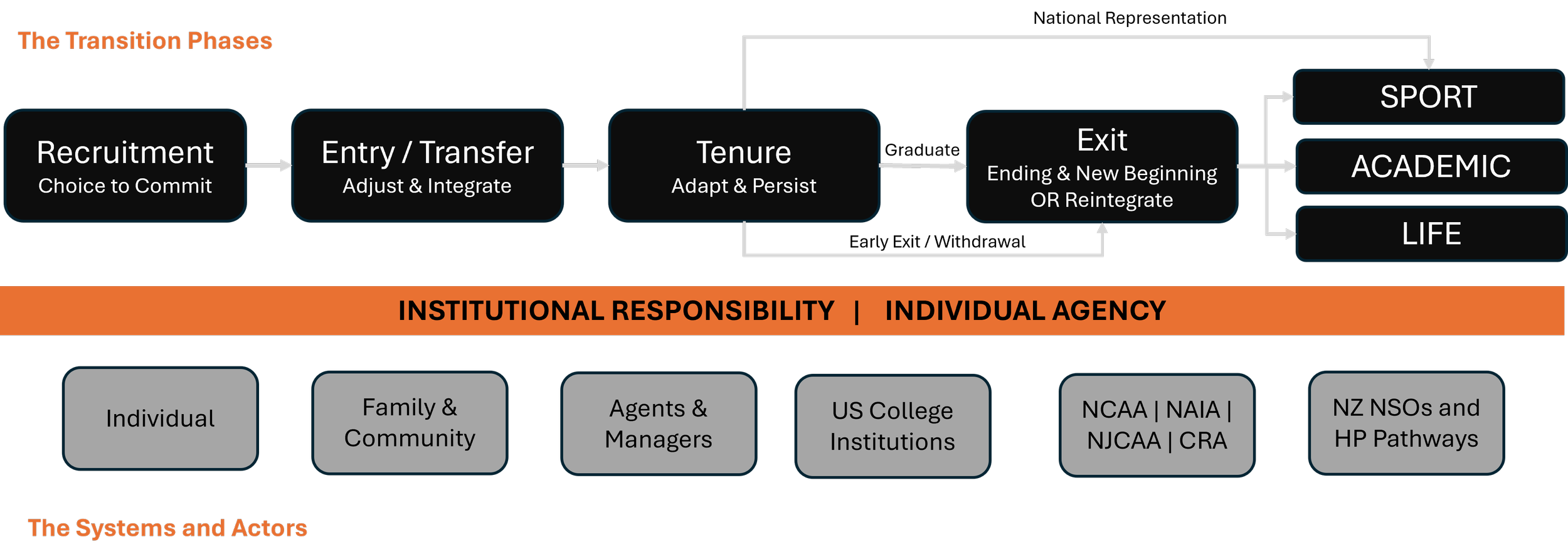
SOURCE: Adapted from Thomas et al., 2023 - PhD Thesis
The systems surrounding these athletes — sport organisations, recruitment agents, collegiate institutions, family and community — each carry obligations across the pathway. How well they understand and discharge those obligations, and how athletes navigate within what those systems make possible or fail to provide, is what this project is designed to examine.
Who is Involved
Five actor groups sit at the heart of the research:
The individual athlete — not a passive recipient of the pathway, but a person making choices under constraint across all four phases.
Family and community — geographically displaced but not relationally absent. For Māori and Pasifika athletes, collective obligation carries real weight across the full pathway.
Agents and managers — most consequential at the commitment decision, least accountable when the consequences arrive.
US collegiate institutions — controlling eligibility, visa conditions, and the coaching relationship. Committed to an educational relationship, not just a performance one.
NZ sport organisations — upstream selectors and downstream beneficiaries of a system they do not govern and rarely monitor.
Ethical Approval
For the formal documentation outlining your inclusion criteria and the parameters around your consent to contribute to this project as an interview participant click:
here if you are a US-Collegiate NZ student-athletes, OR
here if you are someone who is involved with their pathway
Survey/Questionnaire participants are informed and consented in the Qualtrics survey itself.
This project is funded by Fulbright New Zealand and conducted in collaboration with AUT SPRINZ and Illinois State University. For enquiries about the research or to participate, contact pip@continuumhub.co.nz